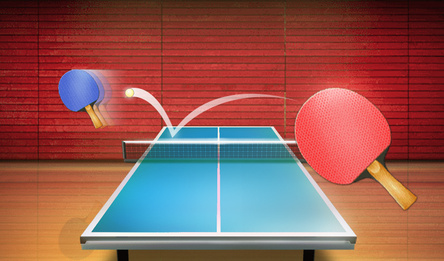
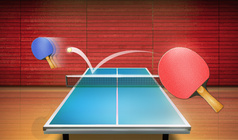
Choose your country, grab a racket and enter the tournament bracket.
Three championships await you: in Russia, there are sixteen participants and a relaxed start; in Europe, thirty-two players are ready to return your serve; and in the World Championship, games go up to eleven points, and you must win by at least two points. Each subsequent tournament is like a locked door: either you open it or you don't.
Opponents are divided into seven skill levels. Beginners play simply and predictably, while advanced players cover almost everything and punish any weak shots.
The ball responds to your touch: a quick swing results in a direct hit, a circular motion of the racket creates topspin and makes the ball curve, and a gentle touch produces a chop that falls just behind the net.
Your progress is saved, and if you advance far enough, a cup will appear in your place in the bracket.
How to play
Controlling the game with a mouse or your finger is straightforward: the paddle tracks the cursor, and the stroke is the movement you make.
To serve, simply drag the paddle across the ball for a regular serve without a toss. For a powerful serve, quickly tap the ball twice and hit it on the way down. To add topspin, toss the ball, draw a circle with the paddle, and finish on the ball. For a chop, toss it and lightly touch it with almost no swing.
During rallies, swipe through the ball to return it — the force of your swipe determines the strength of the shot. Drawing a circle adds topspin, while a gentle, short stroke makes the ball drop just behind the net.
Scoring works as follows: the first two championships go up to five points, and the world championship goes up to eleven points. You need a two-point advantage to win. Service switches every two points and after each rally in case of a tie.
The training mode covers all these aspects and introduces topspin and chop before the European tournament. If you find a rival too tough, you can lower their level after a defeat.